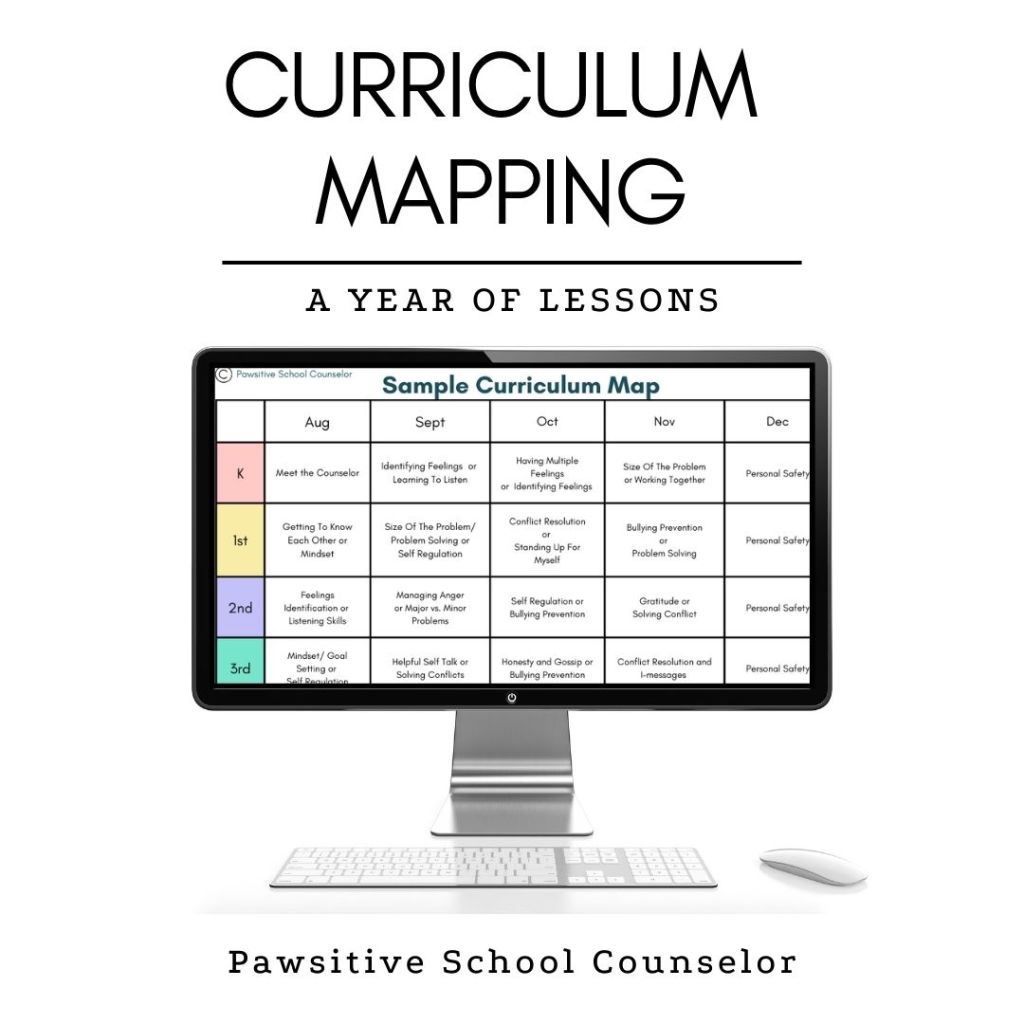
Every year, I tell myself this will be the year I create a curriculum map I love—and actually stick with it for a few years. I promise I won’t spend another summer tweaking and reworking it. But then… I discover a new strategy I love even more. A fresh picture book gets released and sparks a whole new idea. Or, you know… a global pandemic happens.
So yes—changes have been made, and more are always on the horizon. In this post, I’m sharing what I’ve learned, what I’ve updated, and how I’m planning smarter (not harder) moving forward. Let’s dive in!
1. Start with your students
Before plugging anything into a schedule, pause to reflect on the needs of your school community. Use data, referrals, and student feedback to guide what topics should take priority. A student-centered map is always more meaningful—and more likely to be used.
2. Align with standards + what’s happening in your building.
Yes, your map should reflect the ASCA Mindsets & Behaviors—but don’t stop there. Cross-check with your school calendar (testing, spirit weeks, etc.) and collaborate with teachers to make sure your lessons land at the right time.
3. Build in Flex Weeks and Wiggle Room
Things will change—assemblies pop up, fire drills happen, and students need different things than you expected. I leave space in my map for flexibility so I’m not constantly rearranging all year. A former principal suggested to me one year when I was rotating to do 2 weeks on and 1 week off I loved that she encouraged me to make time for my program and me!
4. Repeat what works
You don’t have to reinvent the wheel every year. If a lesson or activity was a hit (and met your objectives), plug it back in. Save time and mental energy by reusing strong content—then tweak as needed based on this year’s group.
5. Use your map as a guide
Use your curriculum map as a guide, not a set-in-stone plan. It gives direction and structure, but you’re allowed to detour when something better fits your students’ needs in the moment. Stay flexible—it’s one of your superpowers as a counselor.
An Important Note About Aligning Your Curriculum Map to Standards
It’s easy to feel like every standard needs to fit neatly into a lesson plan or curriculum map, but many standards are meant to be implemented across the entire school counseling program—through classroom instruction, small groups, individual planning, consultation, collaboration, and schoolwide initiatives.
ASCA’s standards reflect this broader approach. The ASCA School Counselor Professional Standards & Competencies describe the knowledge, attitudes, skills, and behaviors counselors need to implement a comprehensive school counseling program. These standards encompass direct services to students as well as indirect services provided through collaboration with families, teachers, administrators, and community partners.
The document explains that “the behavior standards include essential behaviors school counselors demonstrate through the implementation of a school counseling program including: 1) professional foundation – the essential skills that are the basis of a school counselor’s professional orientation; 2) direct and indirect student services – interactions that are provided directly to students or indirectly for students in collaboration with education partners, such as families, staff, administrators, decision-makers, and any other school or community organizations/individuals; 3) planning and assessment – activities necessary for the design, implementation, and assessment of the school counseling program” (American School Counselor Association (2025). ASCA School
Counselor Professional Standards & Competencies. Alexandria,
VA: Author.)
This means that while classroom lessons are important, many standards can be met through other activities, collaborations, and program components—helping you create a map that truly reflects the comprehensive nature of your work.
Similarly, many state standards use language that focuses on supporting student success rather than delivering specific classroom lessons. For example, Tennessee uses this language to guide the implementation of the standards: “Standards guiding school counseling programs to implement strategies and activities to support and maximize each student’s ability to learn.”
As you review your standards, ask yourself:
- Does this standard need to be taught in a classroom lesson?
- Could it be addressed through another program activity or support?
- What approach would best meet the needs of my students and school?
When we stop viewing standards as a checklist of lessons to teach, we create space for a more responsive and meaningful program. The goal isn’t simply to “cover” standards—it’s to use them as a framework for meeting the unique needs of your students and school community.
Notes about this curriculum map
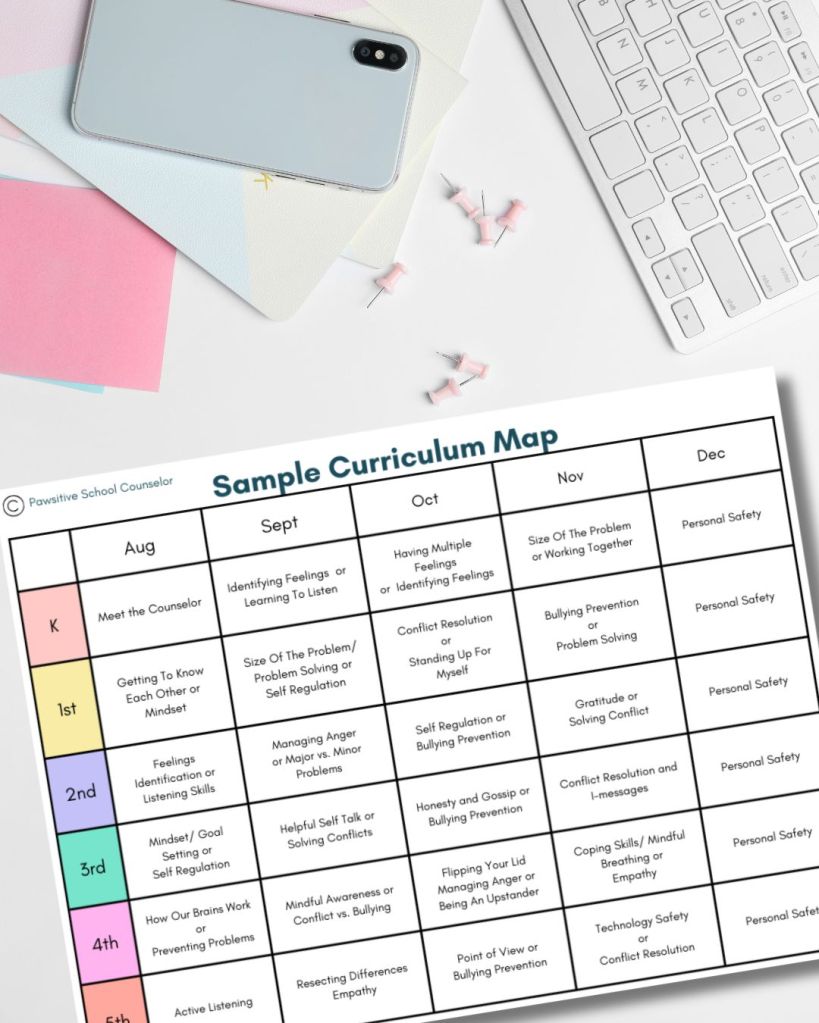
This is a sample curriculum map with general ideas for classroom lessons. You may see students more frequently than I do and choose to add additional topics. While this is just a guide, consider adjusting your map to fit your school’s unique needs by reviewing:
- Student needs
- Referral trends from the previous year
- Program goals
- School-wide data (discipline, attendance, academics)
- Feedback from program surveys and needs assessments
What curriculum do I use for the lessons? I have used a variety of curriculum’s in my career; here are just a few:
- Fostering Empathy
- Pawsitively Mindful
- Picture of Pawsitivity
- 30-Minute Groups: Executive Function
- Quaver
- Mind Up
- Ned Show
- Connected and Respected
- Lessons I find on TPT
Looking for books to partner with lessons?

I love pairing picture books with my lessons—they bring concepts to life in such a meaningful way. In fact, I’ve even built entire lessons around some of my favorite book series!
If you’re looking for the perfect book to complement your teaching, be sure to explore my comprehensive book database. You’ll also find a helpful map below with lesson-aligned book suggestions to spark ideas and save you time.
See a past sample of my curriculum map here.
PAWS lessons (Pawsitively Awesome and Wonderful Students) are mini lessons that I share with teachers to show to students before or after their counseling class. It serves as a refresher or introduction. I often record myself teaching these lessons using Apps such as Loom or Screencastify.
The caregiver and teacher support are provided in many different formats including presentations, handouts, emails, consultations, etc.
Mindful workshops can be provided to students during the day. When I offer a workshop I open it up to any student in certain grades. For example, I may host a workshop on Monday for any student in 4th grade during recess and on Thursday for any student in 5th during lunch. You can also make them stations at a parent night. I use this packet to help put together these workshops.
See my past maps here:
2020-2021
Classroom lesson map: Editable Excel or PDF
Whole school and small groups: Editable Excel or PDF
2019-2020
Classroom lesson map: Editable Excel or PDF
Whole school and small groups: Editable Excel or PDF


Leave a Reply