Why a Calm Corner?
Our classrooms can be emotionally intense places. When students are dysregulated (angry, anxious, overwhelmed) their brains shift into survival mode, making learning and connection harder.
Having a break area is a universal strategy. It supports all students who need a moment to regulate.

A calm corner is not about punishment or isolation. Rather, it is a restorative tool. It is a space where students can pause and regulate. They can then rejoin the classroom ready to learn and engage.
In restorative practice, the emphasis is on agency, choice, voice, and repair. The calm corner can serve as a tangible reflection of those values: students choose when to step away (rather than being “sent”), use tools to support themselves, and return ready to reconnect.
Also, the physical environment matters. Research has shown that access to natural light in classrooms correlates with improved cognitive performance, attendance, and mood. Placing your calm corner near a window or in a brighter, more natural‑light zone can subtly support regulation (provided glare is managed).
With that foundation in mind, here’s how you can create, teach, and maintain a calm corner in your space.
Setting Up the Calm Corner
Below are practical suggestions and guiding principles to help your corner be effective, welcoming, and sustainable.
Location & Layout
- Choose a quiet-ish corner of the room—away from high‑traffic or noisy zones—but still visible to you. The student shouldn’t feel completely hidden or cut off.
- If possible, situate it near or with access to natural light (but avoid direct glare). The positive effects of daylight on mood, cognitive function, and well-being make this an ideal spot.
- Use low partitions, bookshelves, or screens (not solid walls) to delineate the space while preserving teacher visibility and supervision.
- Make it cozy: add a soft rug or mat, cushions or a beanbag, pillows, perhaps a cozy chair.
Materials & Tools
When selecting items, remember: these are tools, not toys. Everything in the space should support regulation, introspection, and calming—not distraction or play.
You can find some of my favorites on Amazon here.
Some possibilities:
- A visual “relaxation menu” or choice board listing strategies students might use (breathing, drawing, reading, listening to soft music, counting, guided imagery)
- Breathing visuals or posters (e.g. “square breathing,” “bubble breathing”)
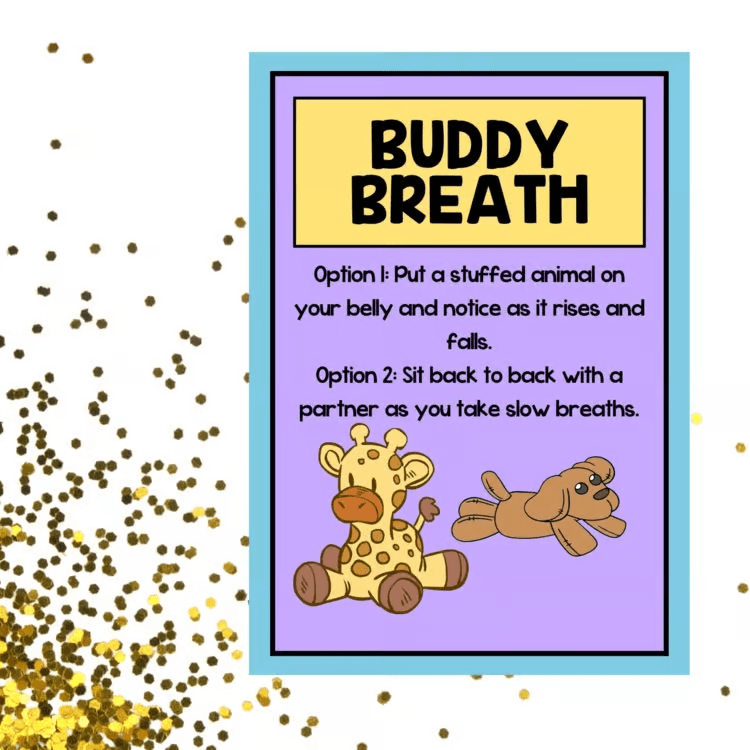
- Fidget or sensory tools (stress balls, putty, tactile objects) — be selective and teach how to use them.
- Journaling/drawing supplies: blank paper, colored pencils, markers, coloring pages
- Quiet reading materials
- Headphones and soft music or guided meditations (so sound doesn’t disrupt others). One year I wrote a grant to incorporate Vital Sounds headphones and music. These individual music players were very successful.
- A calm reflection sheet (optional): a short prompt like “What I’m feeling / What tool I’ll use / What I’ll do next”
- A small plant or nature imagery (natural elements can help calm)
Find my Calm Corner essentials here.
Be intentional: don’t overcrowd the corner with toys or distractors. Start simpler, then add as needed.
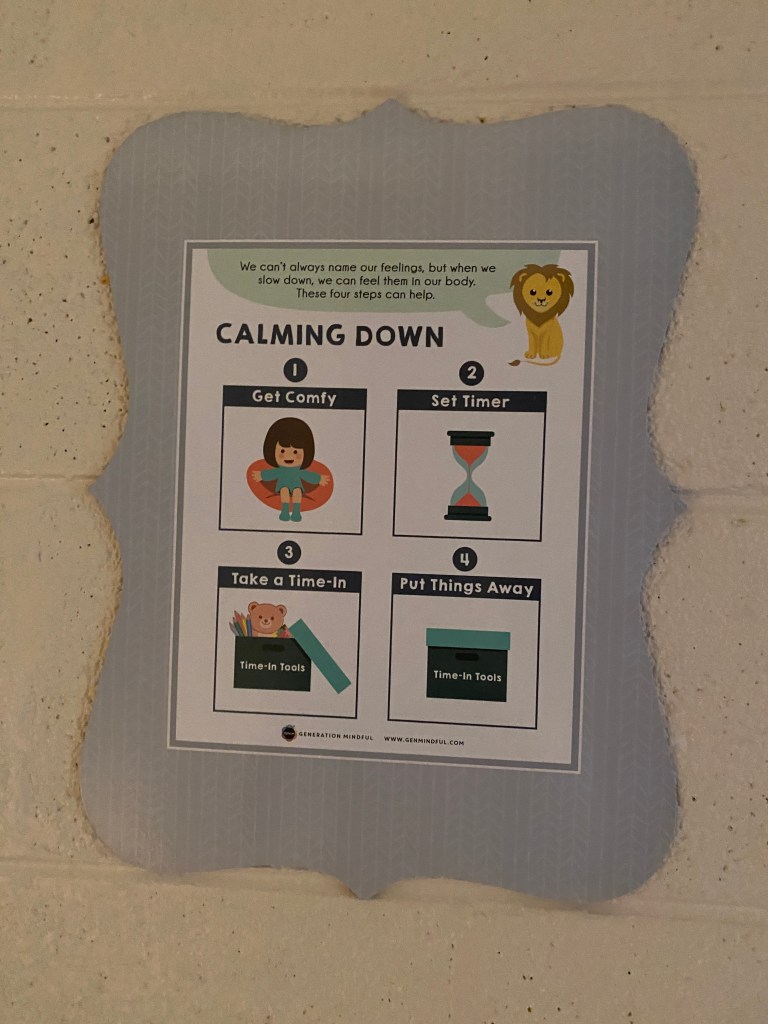
I really like the resources from Generation Mindful’s Time-In Toolkit and wrote them into a grant several years ago.
Teaching Students to Use the Calm Corner
A calm corner is only effective if students know how and when to use it. Here’s a step‑by‑step plan to roll it out, grounded in restorative approaches and responsive counseling:
Implementation Script & Introduction
You can begin with a class discussion / mini-lesson like:
“Have you ever felt really upset at school—maybe angry, worried, sad? When that happens, it’s hard to learn or make good choices.
Our classroom has a Calm Corner (Peace Corner). This is a place you can go when your feelings feel too big to keep inside. It’s not a punishment—it’s a tool to help you calm your brain and body so you can come back ready to learn.
In this corner, there are tools to help you: breathing exercises, drawing, reading, quiet music. But tools are tools, not toys. We’ll learn exactly how to use each one.
Today, we’ll all practice using the corner together, and you’ll each get a turn.”
This aligns with restorative practices: introducing it as a support, not a consequence.
You can find a printable script here.
Modeling, Practice, and Role-Play
- Model it for them. Take your own short break there. Narrate your thought process (“I notice my shoulders are tight and my head feels loud—so I’m going to take three deep breaths in the calm corner”).
- Role play with students. Have students come up one by one (or in small groups) and simulate “I’m feeling frustrated—I’ll go to the calm corner, pick a tool, and self-regulate.”
- Post and practice expectations. Put up a chart visible in the corner that lists how to enter, how to select a tool, how to exit, how to reflect, etc.
- Practice regularly (especially early in the year): schedule times when students visit, or simulate a scenario.
- Build language: Teach them phrasing they can use.
- Example: “I am frustrated right now. I need to take a break in the calm corner.”
- Practice until they can say it back.
- Use consistent naming and visuals across classrooms or the school if possible (for coherence).
By engaging students in the process, you build ownership, reduce stigma, and promote internalization (key restorative tenets).
I also love using books to introduce the calm corner. Here are 15 books you could use to introduce the space and teach kids about emotional regulation.
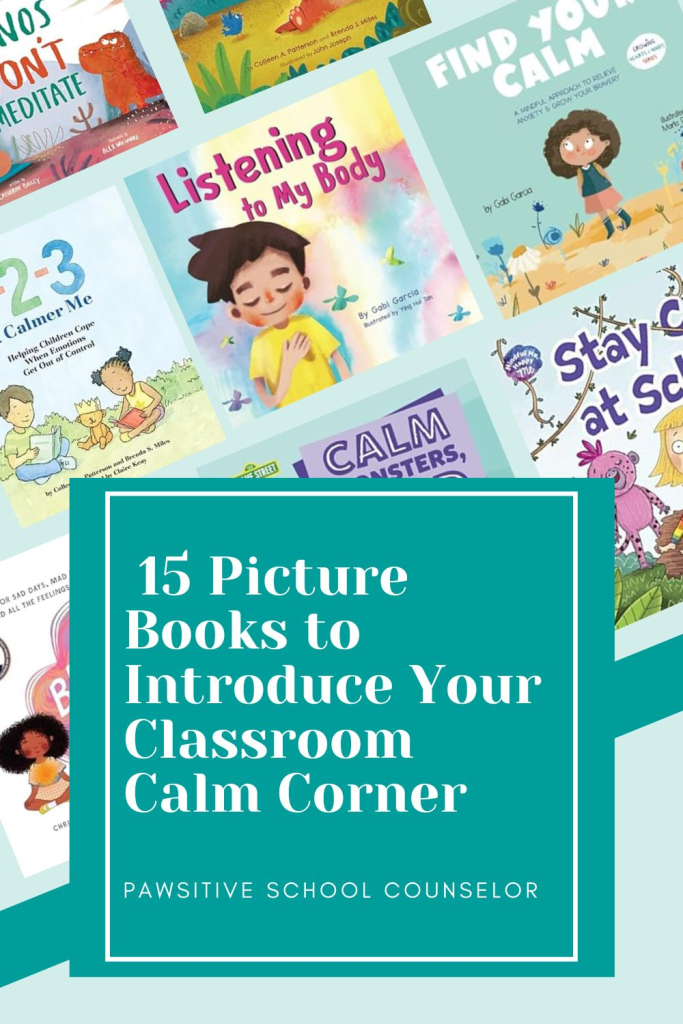
You can find my books for Calm corners on Amazon here.
I also like recording a mini lesson/video for teachers to show their students at the beginning of the year. This allows everyone to hear the same messaging about expectations. You can get the mini lessons here.

Whole Child Counseling also has one on YouTube here.
Cueing & Inviting Students
When you notice signs of dysregulation—body tension, facial expression, tone—use gentle prompting:
“I notice you’re clenching your fists / your face seems tight. Are you feeling frustrated right now? Would you like to take a few minutes in our calm corner while I think alongside you?”
You can script slightly different variations:
- “I see you frowning / pressing your lips—any emotion you want to move out with a break?”
- “It looks like you might be getting upset. Would a calm corner break help?”
Over time students can learn to self-cue (“I’m noticing tension, so I’ll go use the corner”) when they feel dysregulated.
Tips & Considerations
- Avoid using it as a punishment or “time-out.” The corner must be a place of safety and self-care, not discipline. If students feel “sent” there, it loses credibility.
- Be mindful and cautious with timers. Timers can help prevent students from staying too long or using it as avoidance, but they also risk implying a “deadline” for emotional recovery.
- Use timers carefully (especially in early use or with frequent users).
- Gradually fade timers if possible.
- When using a timer, pair it with reflective talk: “Here’s your time; when it ends, we’ll debrief and return.”
- Some teachers use a choice of timer duration (e.g. 2, 3, or 5 minutes) so students maintain agency.
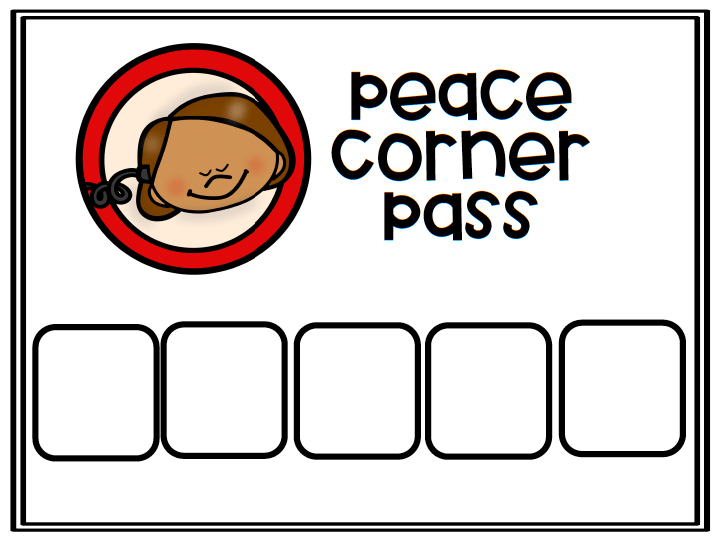
- Use break cards for frequent users. You might give a limited number of break tickets per day or week. Students can “spend” a card to use the corner, which helps manage overuse while preserving choice.
- Let every student visit the corner (non‑emotional use). Early in the year and mid-year, invite all students to spend a little time there—“test the space,” play with tools, get familiar. This normalizes it and reduces novelty/misuse.
- Collect data / observe patterns. Track how often and how long students use the corner. Look for trends (e.g. same students always using it, times of day when use spikes) and adjust practices accordingly.
- Consistency across staff. If possible, use a school wide system when developing the calm corners. For example: use the same name, visuals, expectations, and procedures for calm corners across classrooms or the building. This consistency reinforces norms.
- Be ready to reteach. Periodically revisit expectations, reassess tools, refresh visuals.
- Be patient. It takes time for students to internalize self-regulation and trust the corner.
FAQ
Below are some common concerns and suggested responses.
| Question | Suggested Answer / Strategy |
|---|---|
| Should I use a timer? | It depends. A timer can help structure use and prevent the space being used to avoid work. But be careful: you don’t want to send the message “you must calm down in 3 minutes.” Use timers initially or with frequent flier students, but try to fade them over time. Offer choices of duration. |
| What if a student misuses the corner (plays, throws things, refuses to leave)? | Re-teach expectations. Remind the student that the corner is for calm, respectful regulation. If misuse persists, temporarily restrict access or require teacher permission, then reteach. Use restorative reflection after misuse (“What happened? What did you need? What could you do differently next time?”). |
| What about “frequent flyers”? | Use break cards or tickets. Limit how many times per day/week a student can autonomously use the corner. For students who overuse, monitor patterns and reteach or scaffold alternate supports (check-ins, counseling check-ins, proactive strategies). |
| Is the corner a replacement for adult support/teaching? | No. It’s a supplement. You still check in, debrief with students, and teach emotional regulation skills explicitly. The corner is one tool in your toolkit. |
| When should students be allowed to use it? | Establish clear policies: e.g. students may ask (or self-identify) when they feel dysregulated, or the teacher may suggest it when noticing signs. In earlier phases, you might require a quick “exit ticket” or check-in before use, then gradually allow more autonomy. |
| Can more than one student use it at once? | Depends on space and supervision. In many setups, it’s one at a time to preserve calm and avoid distractions. If you expand it, you might designate multiple “zones” or use adjacent spaces, but monitor carefully. |
| What if my room has no natural light? | Try using bright, natural-looking lights if your room doesn’t have windows. Avoid harsh glare, and make the space feel cozy with warm, soft colors. Research shows that the type of lighting really can affect how calm and focused students feel. |
| How long should students stay? | Start with 3–5 minutes, depending on age and needs. The goal is to reset, not to avoid learning. Adjust based on observation. |
A well-designed calm corner can shift classroom culture. When students begin to see regulation as a shared practice, rather than a punitive expectation, you cultivate an environment of well-being, choice, and repair.
Remember: the corner is not a magic wand. It takes consistent teaching, follow-through, observation, and adaptation. But over time, many teachers report fewer emotional escalations, more student self-awareness, and a classroom climate of trust and safety.
Shop The Post
Find my Amazon favorites here.

Pin For Later

 Pawsitive School Counselor
Leave a comment